Evanston RoundTable, April 20, 2026
This year is the 100th anniversary of Route 66, which officially opened Nov. 11, 1926. Kickoff celebrations to mark the centennial are being held this week. Route 66 is widely considered America’s most famous highway, the “Mother Road” of John Steinbeck’s Grapes of Wrath, celebrated in song and stories, which ran from Chicago through downstate Illinois, Missouri, Kansas, Oklahoma, Texas, New Mexico, Arizona and ending at the Pacific Ocean in southern California.
“In honor of the big birthday,” reports the New York Times, “many museums along Route 66 have created exhibitions exploring the role of the iconic automotive corridor in American history and culture.”
I drove the length of it in February 1973 to pick up my best friend Jay, who was quitting his job as night manager of the Los Angeles Playboy Club for a road trip to Vancouver, where a friend of his was letting us stay.
It wasn’t Route 66’s iconic status — including even its own TV show — that attracted me. Before it was superseded by interstate highways, it was the best way to get from here to there, some 2,400 miles from Chicago to Santa Monica, California — passing through scores of small towns and a few larger ones, famously name-checked by Bobby Troup in his song (Get Your Kicks on) Route 66: “Now you go through St. Looey; Joplin, Missouri; and Oklahoma City, oh so pretty; you’ll see Amarillo; Gallup, New Mexico; Flagstaff, Arizona; Don’t forget Winona; Kingman, Barstow, San Bernardino…”
It’s a wonderful, bouncy, joyous song, guaranteed to perk up your day, and I’ve listened to many versions (Nat King Cole, Chuck Berry, the Rolling Stones, Asleep at the Wheel) to bring you what in my opinion is the best.
According to Wikipedia, the named cities were selected by Troup and his wife as they drove cross-country in the mid-1940s to a new career as songwriters in Los Angeles.
I was heading to L.A. too, but not to start a new career — I would begin work as a cub reporter at a Chicago community newspaper later that year — and not in my own car; I didn’t own a car for another decade. It was a private vehicle, leased from a drive-away company for a small fee so I could deliver it for the owner. I was responsible for gas, around 40 cents a gallon at the time, plus meals and overnight accommodations — still cheaper (and way more interesting) than flying. The car I was assigned was actually being delivered to Berkeley, California (375 miles north of L.A.), but that was still within the drive-away firm’s mileage allowance from Chicago.
‘White Line Fever’
I was in a hurry to get to L.A. and pick up Jay so we could start our adventure up the coast. But to do the trip right, I had to start where the road began. So from the drive-away firm’s North Side garage I drove downtown to Michigan Avenue and Adams Street, which was then the eastern terminus of the route (today’s it’s at nearby Navy Pier), and headed west. I was in the throes of what I called “White Line Fever,” putting on as many miles as I could, which was impressively far. Driving solo all day with few stops, fueled by the incredible vitality and sitzfleisch of youth, I made it on the first day to Oklahoma City and on the second to Albuquerque, New Mexico — a total of 1,300 miles in all.
Strangely, I have no recollection of stopping at any of the many gift shops, charming diners, unique motels and unusual tourist sites along the route.
The only notable memory I have from that leg of the trip was late the first afternoon, somewhere in southern Missouri or northeast Oklahoma, nosing along southwest, when I spotted a curious bright light hovering in the sky many miles ahead for what seemed like a very long time, maybe 15 or 20 minutes. As a kid I had seen my share of sci-fi movies, so I knew what a flying saucer was supposed to look like. Wouldn’t that be wild, I thought, waiting for it to speed off or beam me up. But eventually the light resolved into a regular old airplane lit up by the setting sun, dashing my extraterrestrial fantasies.
More memorable though no less alien was stopping in the Petrified Forest National Park, which included the Painted Desert, in northeastern Arizona on the third day of the trip. Route 66 exactly bisected the park, so it was easy to pull over, get out and look around. Never had I experienced such stillness and silence as I did scanning the vast, eerie and beautiful moonscapes. (Sadly, having since developed tinnitus, I never will again.)
The only photo of me from the cross-country trip was taken at the South Rim of the Grand Canyon, which wasn’t even on the route; I had detoured 90 minutes north from Flagstaff so I could check out the canyon. It was cold and dreary that afternoon, so I walked up to the rim, looked down, had someone take my picture, and piled back into the car to retrace the route.

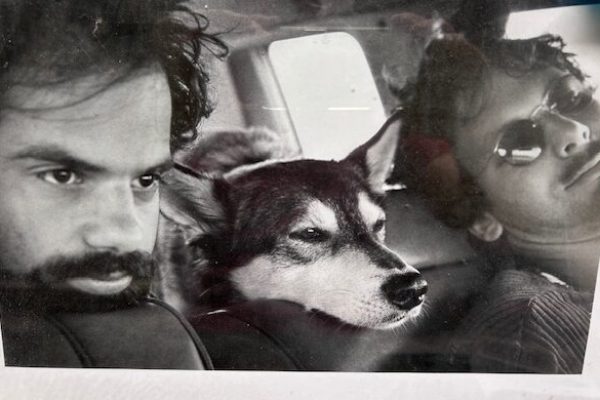
After crossing the Mojave Desert on the fourth day, I picked up Jay in L.A. and we made our first excursion north. He was as eager as I was to get going. We had a companion, Jay’s amazing dog Alaska, which he’d acquired as a puppy while living in Anchorage. Jay claimed Alaska was part wolf, and I could believe it: He was the fastest dog I ever saw, and despite being rather skinny, was ferocious and utterly fearless when challenged by another dog.
Our first problem
We spent the first night in sleeping bags by the side of the road. Next day, or perhaps a few days later, heading north on Highway 101, hugging the coast where we could, we pulled over to stop at a roadside field to let Alaska run around and take care of business. That’s when we noticed something disturbing: he was rolling ecstatically on his back. Jay called him over and we confirmed the worst: Alaska was smeared with fresh, highly aromatic cow manure. This was a troubling development, since I certainly couldn’t deliver the car smelling that way.
Desperation is the mother of invention, and Jay’s solution was to immobilize Alaska by holding him down with his shoe in the passenger side floor of the car while I hurriedly drove us north to the next town. We located a fire station and asked if we could use a hose. The firemen chuckled heartily watching Jay give Alaska a thorough power-wash with Head & Shoulders shampoo.
In San Francisco we crashed with a friend, a former Chicagoan I knew from college, and wandered around entranced by the great city. After dropping off the car in Berkeley, we picked up another drive-away vehicle going to Seattle and headed north. Our journey took us along the ocean, past herds of elk grazing on a roadside hill and through tall fir forests where Highway 101 veered inland.

I had hoped to circumnavigate the Olympic Peninsula west of Seattle, but we couldn’t chance it: We were close to the limit of allowed mileage, and adding an additional hundred miles driving the park’s peninsula road might put us over, leaving me to face steep financial penalties. As it turned out at the garage where I dropped off the car they didn’t even look at the odometer.
Crossing the border
From there we rented a car to take us the rest of the way to Vancouver. In those days, no passports were required to cross into Canada, which was usually a routine formality. Not this time. At the border north of Bellingham, Washington, the Canadian customs officer pulled our car out of the line and asked us how much cash we had. Between us we counted $165. He turned us back without explanation. We surmised it was because many young American men like ourselves were going to Canada to escape the U.S. military draft and then living on the dole.
What to do? At a coffee shop nearby, a trucker sitting at the next table overheard us considering our dilemma. He leaned over and suggested another border crossing about 25 miles east, in Sumas. “It’s quieter there, we use it all the time,” he said.
The only question the border patrol officer at Sumas asked was whether Jay had a rabies certificate for Alaska. Knowing Jay’s famously disorganized personal life, I despaired. But after rifling through his wallet, Jay triumphantly produced the required card, and we were ushered through. “Whoo hoo!” we yelled, delighted at having stuck it to “the Man,” as authority figures were called in those days, and high-fived as we pulled away.
Vancouver was dreary and rainy, however, and I only stayed a couple of days before returning home. Jay and Alaska followed a few weeks later.
Jay and I had many other adventures over the years: seeing Muhammad Ali train in Miami and selling our stash of marijuana to pay the fine for a speed trap violation in Louisiana; walking through the Everglades early one morning and seeing a snake chasing a frog in mortal combat; and watching the riotous activities up close during the 1968 Democratic National Convention. Driving the Mother Road to L.A. and ambling up the west coast with Alaska might have been the best of all.

Decades later, in 2016, driving with my son from L.A. to Chicago, we got off Interstate 40 and drove about 30 miles of old Route 66 in Arizona. (There are many stretches of the road still in use.) The route went through several towns and at one we stopped and bought a refrigerator magnet as a memento. Other than that and despite all its fame, it still wasn’t all that impressive — just a two-lane road.
But in a sense this isn’t really a story about Route 66. It’s a story about having fun and making happy memories, about picking up and doing amazing things, which anybody with a sense of wanderlust can do at any age.
Get your kicks while you can!