Evanston RoundTable, Oct. 19, 2026
It began with a random conversation outside the Albany (N.Y.) train station, where the Lakeshore Limited stops every afternoon to pick up Chicago-bound passengers arriving from Boston.
I was on my way back from New York City, a trip I make every year to visit friends and family. I always take the train home: There is no better mode of transportation, as I’ve written before, seeing America roll past your window as you relax in comfort and make friends of strangers.
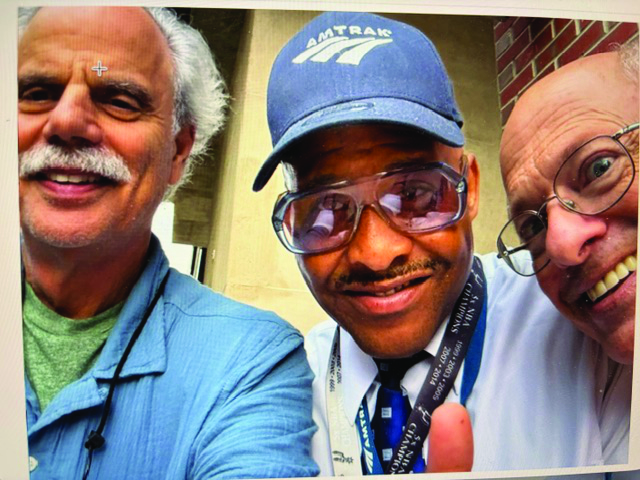
Which is what happened on the Albany platform. An older gentleman was chatting with my very friendly and helpful car attendant, Rob Jones, and (as I often do) I poked my nose into their conversation.
Turns out the gentleman was John Barton (on the right in the featured image), and he was heading to — of all places — Evanston, for the annual convention of the Electric Railroaders Association, which was meeting in late August at the Holiday Inn on Sherman Avenue.
Barton is a retired librarian and schoolteacher who lives in Kent, Connecticut, and is a fellow train fan. He’s a member and past archivist of the Danbury Railroad Museum and estimates he’s traveled on Amtrak more than a hundred times, 20 times alone on the Lakeshore Limited, which goes back and forth daily between Chicago and New York and connects at Union Station in Chicago to the California Zephyr when he’s heading west across country.
“I haven’t flown in 20 years,” he told me.
Unconventional convention
The convention was led by Bob Newhouser, president of the ERA, who described it as a nonprofit educational organization “consisting of people from all walks of life interested in the history and progress of electric railways.” Electric includes buses, trolleys, elevated and subway cars, light rail and some passenger trains, and excludes steam and diesel.
The 60-plus attendees had, to say the least, a hectic schedule over six days. They visited the East Troy Railroad Museum in Wisconsin and the Fox River Trolley Museum in South Elgin. The train “enthusiasts” (considered the polite term, the more derogatory term being “foamers,” as in, foaming at the mouth) also rode the Milwaukee streetcar, known as “The Hop;” and enjoyed a four-hour excursion on the CTA’s Yellow, Red, Orange and Pink Lines riding on a century-old two-car charter train. They also took the South Shore Line to South Bend and back; and the Metra UP line to Kenosha to ride the local streetcar. On the convention’s last day they visited the Illinois Railway Museum in Union, Illinois, which is one of the largest such electric and steam rail museums in the world.
Talk about foamers!
Newhouser and I and a few other convention attendees were seated in the Holiday Inn lobby late one afternoon, after they had returned from one of their daily outings. I asked them what makes train travel so attractive to enthusiasts.
“It’s the nostalgia, it harkens back to another time,” said one. Another said you could “penetrate more of America.” “Romance of the rails,” agreed a third.
Shrinking network
Romance notwithstanding, the U.S. passenger rail network criss-crossing America has shrunk drastically since the mid-1950s. “From 2,500 daily intercity trains in 1954 (that’s excluding commuter service), fewer than 500 trains were left when the National Railroad Passenger Corp., or Amtrak, took over intercity rail service in 1971,” according to Progressive Policy Institute.
I discussed the incredible shrinking rail system with Northwestern University Prof. Ian Savage, who has been part of the school’s Department of Economics for 40 years and is director of the NU Transportation and Logistics undergraduate program.

Savage said the severe contraction can be attributed in part to the rise of the U.S. interstate highway system and expansion of commercial aviation, starting in the 1950s, which deprived intercity rail of a lot of passenger business. Fewer passengers meant fewer dollars and less funding for infrastructure improvements, setting in motion a vicious cycle of declining service and fewer routes. Since the 1970s, when the National Railroad Passenger Corp. was created, the system has “kind of bumped along,” he said, more or less maintaining the current Amtrak service levels.
Distance between cities drives passenger rail volume, he explained, or as he put it, “geography determines passenger rail.” He said the sweet spot between cities for interurban trains is between 100 and 300 miles — say Chicago to St. Louis (297 miles) or Chicago to Detroit (284). These cities are close enough for passengers to comfortably enjoy taking the train rather than put up with the inconvenience of getting to an airport, the maelstrom and security hassles in the terminals, the discomfort of cramped seats and the terror of turbulent air while in the air and, after finally landing, getting from the arriving airport into town. Closer than 100 miles means it’s simply easier to drive; further than 300 and flying is the more convenient option.
Prosperous corridor
Which is why the northeast corridor — including Amtrak’s Acela route, which runs from Boston to New York (215 miles) and New York to Washington D.C., (230 miles) — does so well. Savage called it “the string of pearls,” a string that also includes nearby cities such as Philadelphia, Newark and Baltimore, close enough so rail travel is highly viable. Another plus for these routes is that, unlike the rest of the country, Amtrak owns most of the tracks, which means it has the right-of-way and can give priority to interurban passenger trains over freight trains that use the same rails.
As for the future of U.S. passenger rail service, he sees high-speed trains potentially serving several intercity routes, including the Dallas-Houston-San Antonio triangle, and the Acela line extending from Washington D.C. to Richmond, Virginia, and perhaps even as far south as Atlanta.
High-speed rail favors landscapes that are straight and flat, he said, which rules out mountainous areas such as the San Gabriel range around Los Angeles or big bodies of water, like the San Francisco Bay, issues which have plagued the planned L.A-San Francisco high-speed train route.
Right now, they’re building “the easy bit,” he said, up the Central Valley of California. When I asked about L.A. and San Francisco, he laughed. “Then you have to go around the mountains, which is very expensive, and getting up the peninsula to San Francisco means the expensive choice of tunneling under the Bay, or going around San Jose in densely packed population areas, which is sure to arouse local opposition.”
Asked whether he was a “foamer,” Savage replied, “No, I’m a transportation economist, first, and then an occasional rail passenger.” The last time he was on an intercity train journey was in 2017 to attend a conference in Minneapolis. He said the trip north along the Mississippi was beautiful but the return trip was marred by a two-hour delay when somewhere near Milwaukee the train hit a bicycle on the tracks.
Not on the schedule: delays
Anyone who rides the rails a lot knows unscheduled delays are a frequent hazard. I’ve written before about an Austin-to-Chicago ride where, 70 miles north of Austin, we were unceremoniously transferred to buses for the two-hour ride to Fort Worth. The reason, we were given to understand, was that the tracks ahead had been washed out from a recent flash flood. But in typical Amtrak fashion, in which broken eggs somehow produce a nice omelet, the trip simply got more interesting. My seatmate on the bus kept me spellbound the whole time telling me her life story.
My fellow train enthusiast John Barton described a five-hour delay on the Lake Shore Limited that caused him to miss his San Francisco-bound connection on the California Zephyr by two minutes. “They told us they were holding the train for us, but then they announced the service order had changed, and we watched the Zephyr pulling out of Union Station as we were pulling in,” he recalled. Amtrak put him and several scores of other delayed passengers up for the night at the Marriott Marquis at McCormick Place.

Dianne Fox, a former Evanston resident who now resides in Austin, has traveled all over the country on Amtrak, including earlier this year on the 30-day, 10-city USA Rail Pass she bought for $250 (a special, half-price deal celebrating the nation’s 250th birthday). She’s made the scheduled 28-hour trip on the Texas Eagle, as the Chicago route is called, between her hometown and Chicago numerous times, sometimes with considerable delays. One such trip ran 12 hours late. “It was just one thing after another: freight traffic and a bad engine and a replaced engine.” Still, she added with some wonder, passengers seem to accept Amtrak delays without rancor. “I always find it amazing how calm everyone is, people seem to take it in stride.” We laughed at the likelihood that airline passengers, stuck on the tarmac for more than an hour, would probably launch a full-scale revolt. Maybe that’s because they expect to get somewhere in a hurry.
No one traveling by train has much expectation of a timely arrival — indeed, being relaxed and laid back is one of the great features of train travel. Which is a good thing, because on another trip Fox reported the engine conked out, lights and air conditioning stopped working, and the train sat idle for several hours. Suddenly train attendants appeared in the observation car with a stack of boxed pizzas from Pizza Hut. “It was like a party!” she said, laughing, but of course, in the ever-mysterious ways of Amtrak, that prompted the question, “How had they managed to get pizza delivery in the middle of nowhere?”
Another time, she said after six hours of delays, passengers were let off late at night at the Gallup, New Mexico, station, long after the station had closed for the day. “We had to beg, borrow and steal a ride to get to our hotel. Amtrak didn’t do anything,” she said. “They just dropped us off.”
Meeting people
So why does she put up with it? “It’s meeting the people,” she told me, “and the great stories you hear, it’s just great fun.” One time she talked with someone who worked for the airlines. “She told me she always traveled Amtrak, she didn’t like flying.” Another time she met a man riding his bike across America, who would hop on the train with his bike for short stints.
Another time she witnessed a coterie of young Amish women serenading a group of 50-year-old ladies, obviously somewhat inebriated, who were celebrating a friend’s birthday. “What was really cool was that the Amish women went over to them and started singing happy birthday. It was just this really amazing moment, such a sweet sight.
“I just remember meeting some really interesting people, being friendly with each other.”
We also agreed trains give you a unique perspective on the country. I often say it’s like going through America’s backyards. Fox agreed. “I tell my kids you see the good, the bad and the ugly of America. You see people camped out, homeless people living in the forests.”
On the upside, she’s seen many amazing sites close at hand, including state capitols, the Arch in St. Louis, Glacier National Park, Columbia River Gorge and the Rocky Mountains. What a way to see the country! “It couldn’t be better,” she said.
‘Always an adventure!’
“I feel like I’m in a time capsule,” Fox concluded. “I’m not in my real life for the length of the trip, it’s like a little break from my ordinary life and it feels really special. I enjoy looking out the window, I enjoy the sounds, I love the rocking, the train whistles, meeting nice people. I just love it all. It’s always an adventure!”
I chimed in with a sight I’ll never forget, on the Texas Eagle on the way down to Austin some years ago. Passing through a small Arkansas town I happened to look out the window and saw a lone horse galloping along a side street, with two or three men on foot giving chase. It was surreal, like a scene out of a Buñuel movie.
You sure won’t see that flying!